
Heavy-Lift Drone Brushless Motors: Power, Efficiency, and Reliability

إليك المقال بالكامل كاملاً وجاهزاً للنسخ المباشر، شاملاً جميع التعديلات الدقيقة لضمان تحول المؤشر إلى اللون الأخضر (Good) في قسم الـ Readability و SEO في Yoast دون الحاجة لأي تعديل إضافي:
Heavy-Lift Drone Brushless Motors: Power, Efficiency, and Reliability
The commercial unmanned aerial vehicle (UAV) industry is undergoing a massive transformation. Modern drone applications have evolved rapidly from simple aerial photography and basic surveying to complex, heavy-duty operational missions. Today, commercial multirotors are actively deployed for agricultural spraying, heavy cargo delivery, emergency response, powerline construction, and cinema-grade film production.
At the core of these advanced platforms, heavy-lift drone brushless motors play a central role. As the muscle of the propulsion system, these motors bear the immense burden of lifting heavy payloads, maintaining aerodynamic stability in violent winds, and ensuring absolute operational safety. Consequently, choosing the correct motor setup is one of the most critical engineering decisions in UAV design.
In this comprehensive guide, we explore the mechanical architecture, critical selection metrics, thermal efficiency challenges, and industry standards surrounding heavy-lift brushless DC (BLDC) motors.
What Defines Heavy-Lift Drone Brushless Motors?
Standard hobby or photography drones generally carry payloads weighing under two kilograms. In contrast, heavy-lift drones transport payloads ranging from $10 \text{ kg}$ to over $100 \text{ kg}$ depending on the airframe configuration (such as quadcopters, hexacopters, or octocopters).
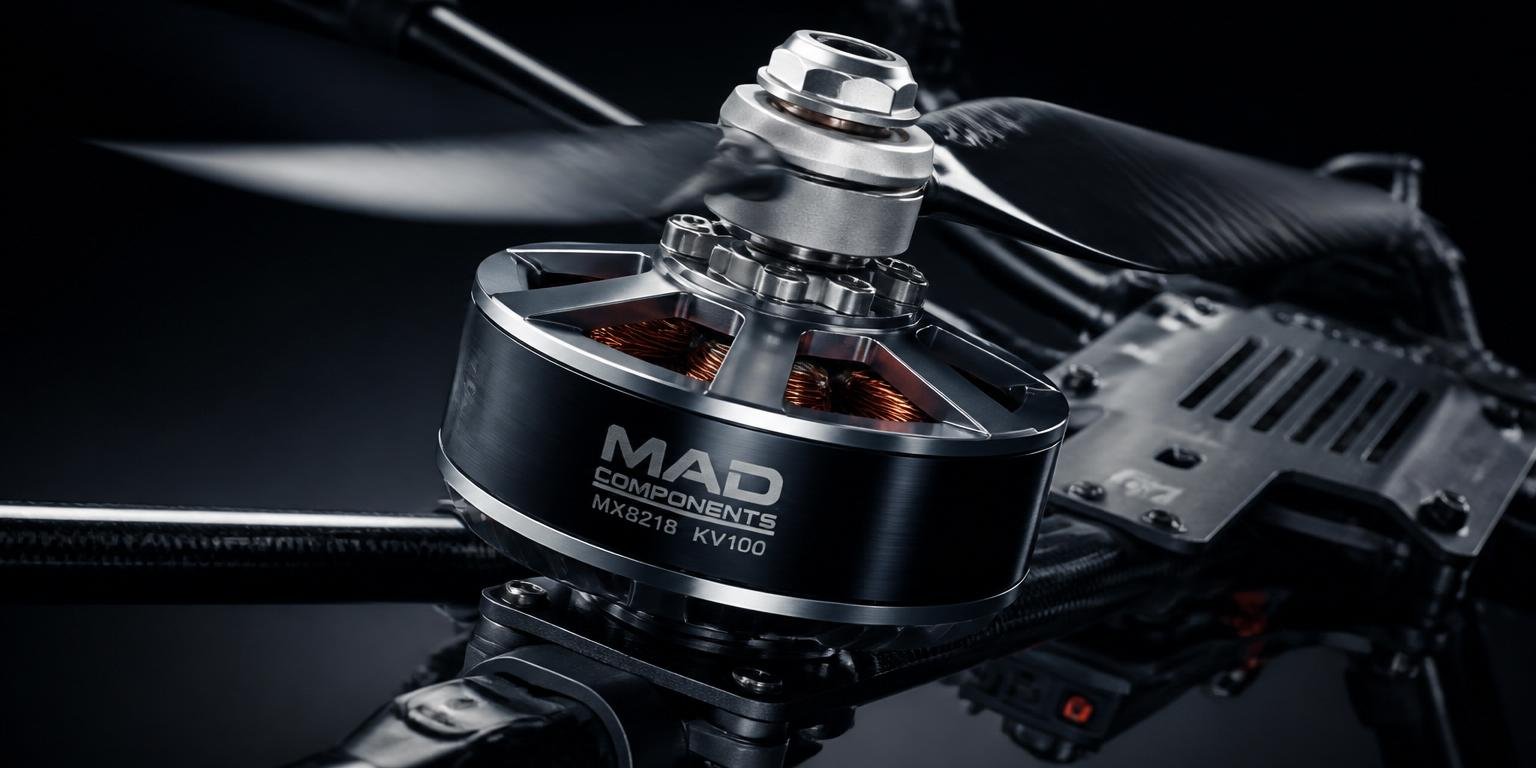
Achieving this level of performance requires engineers to design heavy-lift drone brushless motors with a distinct architectural footprint compared to standard BLDC motors:
- Large Stator Dimensions: Heavy-lift motors feature massive stators (such as 8318, 10025, or 12035 series). Because a larger stator surface area provides ample room for thick copper windings and strong magnetic interaction, it generates high mechanical torque.
- Low KV Ratings: The KV rating indicates the revolutions per minute (RPM) a motor turns per volt of applied power. Modern heavy-lift motors utilize low KV ratings (typically $50 \text{ KV}$ to $150 \text{ KV}$) to turn very large carbon-fiber propellers at lower speeds, thereby maximizing rotational torque rather than raw velocity.
- High-Voltage Compatibility: These motors operate smoothly on high-voltage battery systems (ranging from 12S to 24S LiPo or high-voltage Li-ion setups). As a result, higher system voltages reduce total current draw (amperage), which minimizes thermal losses across wires and electronics.
Key Performance Indicators for Heavy-Lift Motors
When designing or sourcing heavy-lift propulsion systems, drone manufacturers evaluate several core technical specifications to balance payload capacity with endurance.
1. Thrust-to-Weight Ratio and Margin of Safety
Therefore, for heavy-lift applications, maintaining an accurate thrust-to-weight ratio is non-negotiable. For safe commercial operation, the overall propulsion system should maintain a 2:1 thrust-to-weight ratio at minimum, with a 3:1 ratio being preferred for operations in turbulent weather.
For instance, if a fully loaded heavy-lift drone weighs $40 \text{ kg}$, the propulsion system must generate at least $80 \text{ kg}$ to $120 \text{ kg}$ of total combined static thrust. Furthermore, single heavy-lift motors can generate anywhere from $10 \text{ kg}$ to more than $35 \text{ kg}$ of static thrust per rotor axis.
2. Electrical Efficiency (Grams per Watt – g/W)
Battery weight remains the ultimate constraint in drone engineering. Therefore, every extra gram of motor hardware or inefficient power consumption degrades total flight time.
Engineers measure motor efficiency in grams of thrust generated per watt of electrical power consumed ($\text{g/W}$). Top-tier heavy-lift motors optimize their internal copper winding fill factor and magnetic flux density to achieve maximum $\text{g/W}$ ratings at standard hover throttle (typically 50% to 60% throttle). Even a small $5\%$ gain in efficiency adds critical operational minutes to a commercial delivery mission.
3. Thermal Management and Dissipation
Excess heat acts as the primary enemy of brushless electric motors. As a result, high temperatures increase internal electrical resistance, decrease overall efficiency, and ultimately lead to permanent demagnetization of internal neodymium magnets or melted wire insulation.
To counter this, industrial heavy-lift motors integrate several passive and active cooling features:
- Centrifugal Cooling Vents: Specially shaped rotor bells pull cool outside air directly through the internal copper stator windings during rotation.
- High-Temperature Copper Wire: Furthermore, manufacturers utilize high-purity copper windings capable of withstanding operating temperatures exceeding $180^\circ\text{C}$ to $200^\circ\text{C}$.
- Open-Architecture Heat Sinks: Aluminum housings feature extensive surface area fins to quickly dissipate heat into the ambient air stream.
Comparison: Standard Industrial vs. Heavy-Lift Brushless Motors
Understanding the performance difference highlights why heavy-lift operations require specialized hardware rather than scaled-up standard parts.
Environmental Protection and Operational Durability
Heavy-lift drones rarely operate in controlled indoor conditions. For instance, agricultural drones face chemical mist and fertilizer dust; offshore inspection drones deal with corrosive salt spray; cargo delivery drones encounter heavy rain and wind gusts.
For ensuring long operational life and high Mean Time Between Failures (MTBF), modern heavy-lift motors incorporate three essential design elements:
- Ingress Protection Ratings: Sealed enclosures rated from IP54 to IP56 prevent dust particles and high-pressure water jets from penetrating sensitive internal stators and bearings.
- Anti-Corrosion Coatings: Stator laminations and aluminum bell housings receive electro-deposition or specialized epoxy coatings to protect metal components from atmospheric oxidation.
- Oversized Japanese Bearings: In addition, high-load applications utilize oversized, smooth-running NMB or NSK steel bearings to handle intense radial and axial force loads without premature mechanical failure.
Precision Balancing and Vibration Control
Vibration management is a crucial but often overlooked factor in heavy-lift drone design. Large propellers spinning on massive motors generate significant rotational inertia. Consequently, if a motor becomes slightly unbalanced, high-frequency kinetic vibrations travel through the carbon-fiber airframe.
Excessive frame vibration causes several severe problems:
- Sensor Disruption: This interference degrades the accuracy of flight controller Inertial Measurement Units (IMUs), GPS locks, and optical flow sensors.
- Payload Degradation: Such motion creates undesirable rolling shutter “jello” effects in high-end cinema cameras or destabilizes laser-mapping LiDAR sensors.
- Structural Fatigue: Moreover, continuous micro-vibrations weaken carbon fiber arms, loosen mounting bolts, and stress structural aluminum joints over time.
Because of these risks, reputable manufacturers perform multi-plane dynamic balancing on both the rotor bell and the completed motor assembly before shipping, thereby ensuring near-zero mechanical oscillation.
Essential Sourcing Checklist for OEM Drone Builders
If you are procuring or specifying heavy-lift motors for commercial UAV production, ensure your manufacturing partner provides the following resources:
- Dynamometer Performance Curves: Request comprehensive empirical test data displaying voltage, current draw, throttle percentage, thrust ($g$), RPM, and efficiency ($\text{g/W}$) across the full throttle spectrum.
- System Integration Testing: Additionally, ensure the supplier offers pre-tested, co-engineered electronic speed controllers (ESCs) and matched carbon-fiber propellers to avoid electrical synchronization loss or timing slips during rapid throttle acceleration.
- Customization Capabilities: Finally, verify whether the manufacturer offers custom KV tuning, modified shaft geometries, or custom mounting bolt patterns to fit your specific airframe design.
Frequently Asked Questions (FAQ)
Q: What is the ideal KV rating for heavy-lift drone brushless motors?
A: Typically, heavy-lift BLDC motors utilize low KV ratings between $50\text{ KV}$ and $150\text{ KV}$ to turn large propellers efficiently at high torque.
Q: What voltage range do heavy-lift motors require?
A: Most industrial heavy-lift propulsion systems operate on high-voltage setups ranging from 12S to 24S LiPo ($44.4\text{V}$ to $100\text{V}+$ ).
Conclusion
Selecting high-performance heavy-lift drone brushless motors is the absolute foundation of building safe, efficient, and commercially viable heavy-payload UAV platforms. By prioritizing torque delivery, thermal dissipation, structural protection, and precision dynamic balancing, drone integration teams can deploy industrial systems capable of handling the toughest commercial tasks in the world today.